

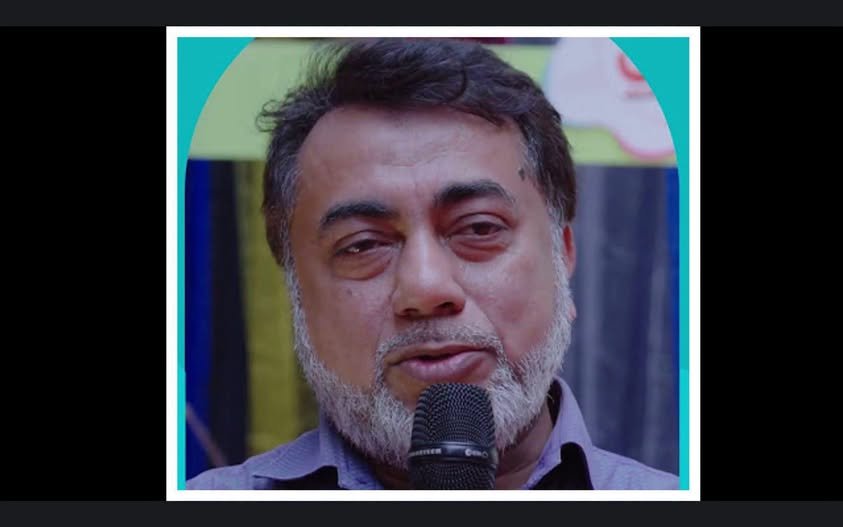
Let me say at the very beginning that this write‑up will be long. If you know the person I am writing about, there is no doubt you will want to read it. And if you do not know him, but want to understand what one friend can do for another, or what a truly altruistic human being can be like, then you may read this with a little patience.
Death is inevitable for everyone, but sadly, we rarely think about it. So when someone close to us dies, we grieve, we cry, but after some days we forget again. Of course, for the family members of the deceased, forgetting is difficult. Allah has promised in the Qur’an that He does not burden a soul beyond what it can bear. So the family gradually returns to normal life. But there are some people whose death creates such a void in our lives that filling it becomes nearly impossible. Life does not stop, but their absence becomes hard to overcome. One such person passed away on Saturday night, creating a void in my life that can never be filled. That day, my friend of forty years, Dr. Abu Hena Abid Zafr, suddenly left this world. Inna lillahi wa inna ilayhi raji’un.
It was the mid‑1980s. I first met him at the first week‑long training camp for Islamic cultural activists in Bangladesh. From then on, we walked the same path together. Within a short time, our relationship crossed organizational boundaries and turned into a deep personal friendship. From the hostel of Salimullah Medical College, our home became his main base. Whenever food was cooked at home, it was assumed Abid would be there. My mother used to say that if anyone other than Abid was going to eat at home, we should inform her beforehand so she could cook accordingly. The difference between Abid and my school or neighbourhood friends was that he was deeply involved with me in both cultural activities and personal life. While he was studying medicine, his father passed away. From then on, he became the guardian of his mother, two younger brothers, and two younger sisters. They all lived in Khulna, while he continued his studies and cultural work in Dhaka.
Allah sends different people with different talents. But very few are given as many talents as Abid had. As a doctor, he did not have many big degrees, but his medical knowledge was extremely sharp. He understood diseases well and could explain them to patients with great clarity. When he worked at the Gastro Liver Clinic, I would often visit him there. Many patients and their relatives would say that they wanted to speak not with the senior consultant but with Abid. Many who read this will agree with me.
His greatest passion was stage drama. I will write later about our work together in theatre. For now, let me say that I do not know anyone in the Islamic cultural arena who studied stage drama more deeply than he did. He had been involved in theatre since his days at Jhenidah Cadet College. The popular actor Tawkir Ahmed learned drama from Abid during their time at the cadet college. Alongside directing many outstanding stage plays, he conducted various training programs on drama. When I visited Bangladesh in December 2024, he told me he was developing a university curriculum on drama. Based on that, he was teaching a course at the International Islamic University Chittagong. Renowned playwright Chowdhury Golam Mawla told me that just eight days before his death, on June 13, he had completed a ten‑day drama workshop. Almost everyone working in Islamic theatre today has been trained by Abid.
Abid had another talent—printing. He worked day and night on various books and magazines and produced publications of exceptional quality. A book by Al‑Mahmud published by his Monalisa Publications even won an award. Many successful people in printing and design were trained by Abid. He also did a lot for me in this field, which I am coming to.
For some time, Abid had also been successfully conducting parenting courses. I did not know this before. But seeing his children, I can say that only a father like him could teach parenting so effectively.
There is an English saying: Jack of all trades, master of none. It refers to people who try to do many things but excel at none. Our Dr. Abid was a rare exception—he was Jack of all trades, master of all. In 1993, my travelogue Himalay Duhitar Ushnatay was serialized in the monthly Kolom magazine and later published as a book. While writing about Abid there, I wrote a few lines inspired by the poem Safdar Doctor (in Bangla). The summarised meaning of this is:
“Doctor Abid, small in size, studies in Mitford (where his medical college is located). Whether it’s my work or yours, or his work or hers, he would never say no to anyone.”
I know many reading this will agree 100% with these lines.
I have countless memories with Dr. Abid—too many to ever finish writing. Here I share a few notable ones:
Late‑night chats in the Red Room
Until 1997, we lived in a tin‑roofed house. It’s during that time that I spent most of my time with Abid. Our home consisted of several tin‑roofed rooms. My room was called the “Red Room” because its floor was red. Built in the mid‑1960s, it had been used by my older brothers before they moved abroad. Eventually, it became my room, and that is where Abid and I spent countless nights talking. My father would always wake me up for Fajr, but when Abid stayed over, he would find the lights still on. One day he said in surprise, “Do you have so many words inside you that sleep doesn’t come?” Most days, we slept after Fajr. This was when I was studying in Aligarh. Whenever I came home on holidays, Abid would arrive with his bags and settle in. My mother would say, “You don’t come home for me—you come for your friend.” So many plans, so many discussions about drama, so many stories of joy and sorrow—those days passed like that.
Publication of my two books
In December 1991, I finished writing my first book, The World’s Best Cricket and Cricketers. It was decided that Abid’s Monalisa Publications would publish it. I handed him the manuscript and returned to Aligarh. Abid and his uncle Zakaria worked day and night to prepare and publish the book. Zakaria Mama was a renowned sports journalist, and was the Sports Editor of Daily Manob Jomin before moving to Italy. I had a small role in bringing him into sports journalism. I was the sports editor of Weekly Sonar Bangla, and he began working with me. After I left for Aligarh, he replaced me. Anyway, Abid and Zakaria Mama did everything for the book except the writing. Some may think Abid profited from it. Not at all. He was not a professional publisher. He did it out of passion. I borrowed money from a friend of mine to fund the printing. Although the book was well‑received among sports journalists, it did not sell well, so there was little financial return. But neither of us regretted it—we did not publish it for profit. Abid named the publishing house Monalisa after his youngest sister, who died at a young age. Publishing his friend’s book and naming the press after his sister—these two reasons were enough for him to work tirelessly.
But the work he did for my other book was purely for me. A publishing house in England was considering printing my PhD thesis as a book. They said they wanted to outsource the printing. I immediately contacted Abid, and he agreed without hesitation. Once again, I stayed abroad comfortably while Abid worked day and night to print the book. That was our Dr. Abid.
Saimum Cultural Festival 1990 – Upodruto Shopnera (Of Troubled Dreams)
One of the greatest achievements of my cultural life was the Saimum Cultural Festival of 1990, when I was the director of Saimum. There we staged the timeless play Upodruto Shopnera, written by Chowdhury Golam Mawla and directed by Abid Zafar, at the Shilpakala Academy. The play was originally written jointly by Mawla bhai and another Chittagong legend, Ahmed Nasimul Huda Naushad, and had been staged several times. Abid and I had gone to watch it. When I was given responsibility for the cultural festival, I naturally turned to Abid for the drama. I gave him a blank cheque—he could choose any play, do it any way he wanted, and I would do whatever was necessary. He had never received such an offer before, and I knew what Abid could do with such freedom. He decided to remake Upodruto Shopnera in a new style and asked Mawla bhai to rewrite it, expanding the 45‑minute play into a two‑and‑a‑half‑hour production.
And so it began. Mawla bhai worked at Dainik Sangram at that time and lived in a nearby mess. Soon he became a member of our household alongside Abid. Under Abid’s direction, he began rewriting the play, adding many new characters. Meanwhile, Abid was busy searching for actors. At that time, former Saimum director Tarek Monowar bhai insisted he must also be included in the play. But he had never acted before! Abid thought for a moment and told Mawla bhai to create a character—a factory union leader—whose speaking style matched Tarek bhai’s natural way of talking. That way, he wouldn’t need to learn acting; he could just speak normally. There were many such stories.
I never acted in plays, but Abid taught me sound direction and gave me that responsibility. In one scene, we needed the sound of dogs barking. We decided to record the dogs at the corner of our street. But strangely, the dogs that barked at everyone were silent that day. What to do? Abid, full of ideas, told Mawla bhai to bark once. As soon as he did, all the dogs began barking together, and we recorded it with satisfaction. Those who acted in that play or worked behind the scenes will never forget Abid.
Every moment of those days will remain etched in my memory. Riding around on motorcycles with Abid, teasing him about eating bones at restaurants, arguing occasionally—later we reminisced about those days so many times. Now I will never be able to do that again.
The 27‑foot letter
Today’s generation will never understand the value of letters in the 1990s. Living in Aligarh, away from family and friends, I felt lonely. So, I wrote letters to everyone and waited eagerly for replies. My close friend and neighbour Dipu wrote regularly. But Abid, due to laziness and busyness, did not. Whenever I felt upset, he would say, “One day I’ll write and make up for everything.” I never imagined how he would make up for it.
One day I returned to my room in Aligarh and found a large envelope. From the handwriting, I knew it was from Abid. I was happy. But the envelope felt strange—something round inside. I opened it and found a rolled‑up bundle. I went outside and began unrolling it. It wouldn’t end! Students from nearby rooms came out to watch. The roll stretched across several rooms. Someone brought a measuring tape. Two people held the ends while I measured. It was twenty‑seven feet long! I checked the time and began reading. It took two hours and forty‑five minutes to finish. Now tell me—has any friend ever written such a letter to you? Aren’t you jealous of my luck?
His contribution to my cricket organization and journalism
Abid was not much into sports. But I was always crazy about sports. So, he had to keep up with me. He published my cricket book. Then in 2002, I organized the first inter‑private university cricket tournament. He took responsibility for the souvenir. He ran around with me collecting advertisements and worked night after night to produce a beautiful souvenir on time, that surprising everyone. A year later, we launched the first Bangla sports website, Bangladesherkhela, with Zakaria Mama and a few sports journalists. Abid invested in it and organised the grand inauguration ceremony at the National Sports Council auditorium. As its first managing director, I came into the limelight and appeared on TV. Abid did everything from behind the scenes. That was Abid—always giving, never taking.
Final words
How much more can I write? I can never finish writing about our friendship. Whenever I needed him, he was there. He dropped everything and came when I called. His advice helped me greatly in my personal life. After I moved to England, communication decreased. He could not always reply to my WhatsApp messages due to his busy schedule. But whenever I needed him, he did everything for me. After my brother returned from being abducted, Abid updated me on his health. When I wanted to hear the story of the July uprising, he invited me to his home and arranged for two coordinators to speak with me. He even arranged a meeting with DUCSU VP Sadeq Kayem (though it did not happen in the end). In everything, Abid stood by me. Nurur Rahman Bacchu, director of Shilpakala Academy and another person trained by Abid, wrote on Facebook, “In times of need or without reason, during family illness—who will I call now, Abid bhai?” Those who knew Abid understand this fully.
The thought that I will never see Abid again makes my heart restless. He has gone to the unknown land, leaving me helpless. Where will I find such a friend? Whom will I call to share my thoughts? With whom will I reminisce? He used to call himself Professor Ghulam Azam’s seventh son. I have lost that brother. May Allah protect my beloved brother and friend. Like a selfish person, I only took from him and could give back nothing except love. Many people like me are indebted to Abid. O Allah, build him a home in Jannah. Protect his beloved wife and his four extraordinarily talented children. I worry for them deeply. O Allah, be their guardian.
May Allah bless
Ameen
So beautifully written Abbu. You were very lucky to have him as a friend, and he was equally lucky to have a friend like you who loved him so much. May Allah grant him Jannah for his pure heart and all that he did for everyone.
Thank you ammu for the nice words and dua. May Allah accept our duas for him.
Really nice words, he was such a nice man I remember meeting him in Dhaka when we visited December 2025. “Jack of all trades, master of all” was a nice touch as well, he will be missed dearly.
Thank you Adam. he was able to show love towards you all in that brief period Masha Allah.
Such a beautiful article, lovely way to remember him by. ❤️
Thank you Safa. Please remember to pray for him.
Well written. Dr. Abid bhai was really a nice and friendly man. We, everybody closed to him, are missing him and feeling his absence. May Allah swt. reward him best